
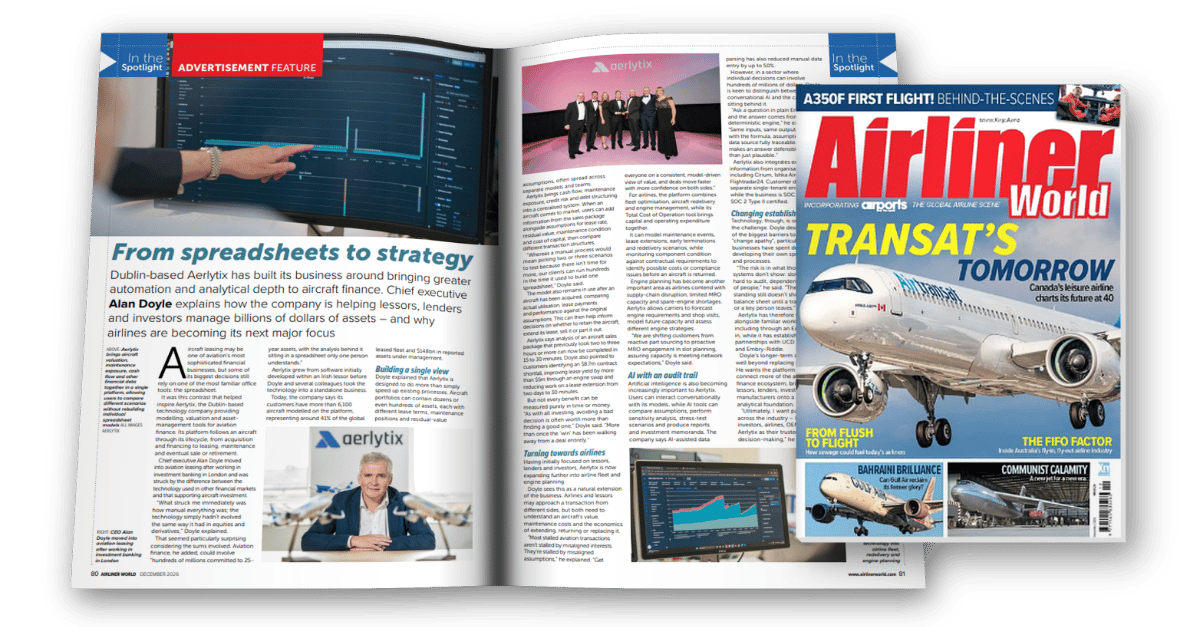
Article courtesy of Airliner World Magazine, December 2027 Issue
Dublin-based Aerlytix has built its business around bringing greater automation and analytical depth to aircraft finance. Chief executive Alan Doyle explains how the company is helping lessors, lenders and investors manage billions of dollars of assets – and why airlines are becoming its next major focus.
Aircraft leasing may be one of aviation’s most sophisticated financial businesses, but some of its biggest decisions still rely on one of the most familiar office tools: the spreadsheet.
It was this contrast that helped inspire Aerlytix, the Dublin-based technology company providing modelling, valuation and asset-management tools for aviation finance. Its platform follows an aircraft through its lifecycle, from acquisition and financing to leasing, maintenance and eventual sale or retirement.
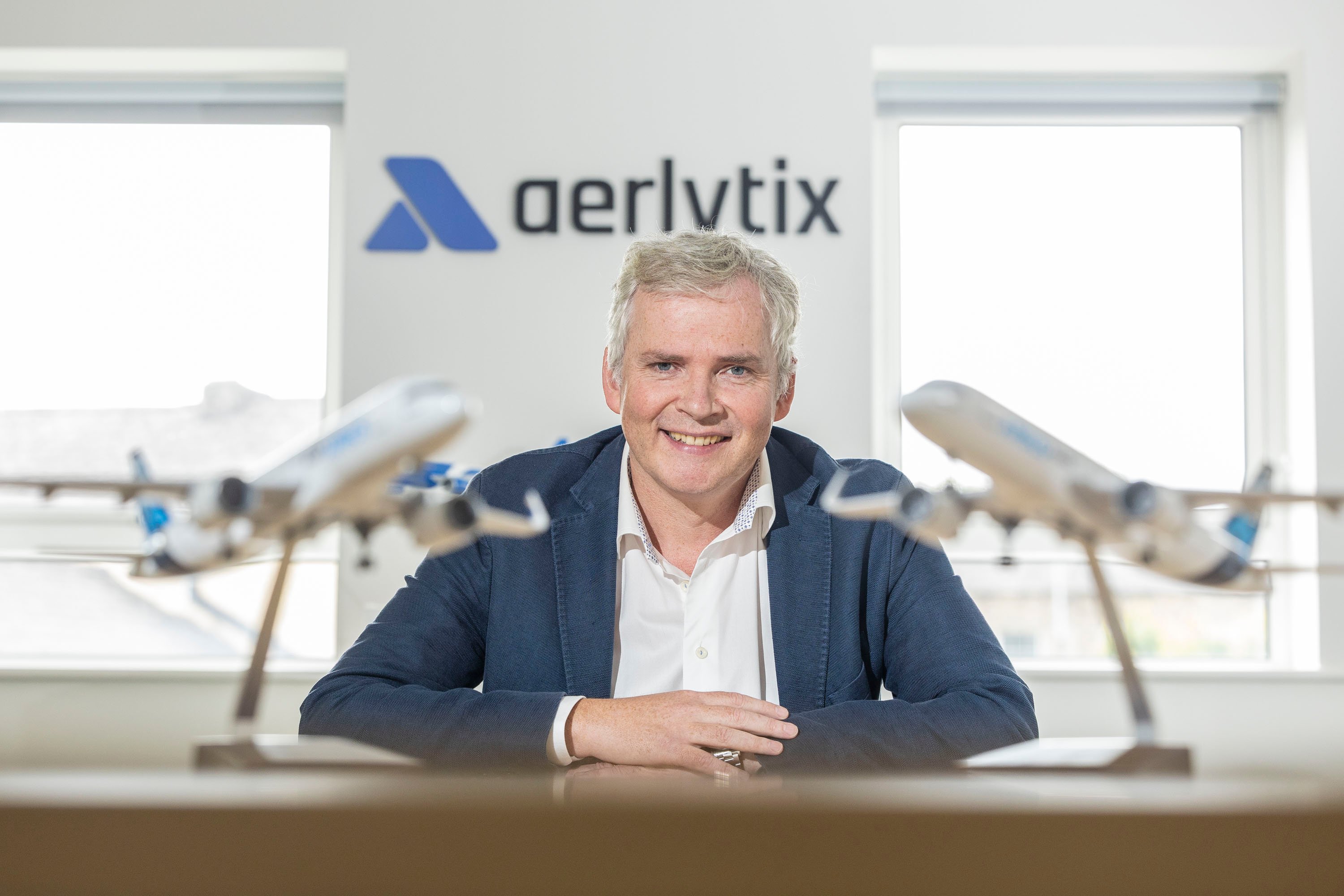
Chief executive Alan Doyle moved into aviation leasing after working in investment banking in London and was struck by the difference between the technology used in other financial markets and that supporting aircraft investment.
“What struck me immediately was how manual everything was; the technology simply hadn’t evolved the same way it had in equities and derivatives,” Doyle explained.
That seemed particularly surprising considering the sums involved. Aviation finance, he added, could involve “hundreds of millions committed to 25-year assets, with the analysis behind it sitting in a spreadsheet only one person understands.”
Aerlytix grew from software initially developed within an Irish lessor before Doyle and several colleagues took the technology into a standalone business.
Today, the company says its customers have more than 6,100 aircraft modelled on the platform, representing around 41% of the global leased fleet and $148bn in reported assets under management.
Building a single view
Doyle explained that Aerlytix is designed to do more than simply speed up existing processes. Aircraft portfolios can contain dozens or even hundreds of assets, each with different lease terms, maintenance positions and residual-value assumptions, often spread across separate models and teams.
Aerlytix brings cash flow, maintenance exposure, credit risk and debt structuring into a centralised system. When an aircraft comes to market, users can add information from the sales package alongside assumptions for lease rate, residual value, maintenance condition and cost of capital, then compare different transaction structures.
“Whereas a manual process would mean picking two or three scenarios to test because there isn’t time for more, our clients can run hundreds in the time it used to build one spreadsheet,” Doyle said.
The model also remains in use after an aircraft has been acquired, comparing actual utilisation, lease payments and performance against the original assumptions. This can then help inform decisions on whether to retain the aircraft, extend its lease, sell it or part it out.
Aerlytix says analysis of an aircraft sales package that previously took two to three hours or more can now be completed in 15 to 30 minutes. Doyle also pointed to customers identifying an $8.7m contract shortfall, improving lease yield by more than $5m through an engine swap and reducing work on a lease extension from two days to 30 minutes.
But not every benefit can be measured purely in time or money. “As with all investing, avoiding a bad decision is often worth more than finding a good one,” Doyle said. “More than once the ‘win’ has been walking away from a deal entirely.”
Turning towards airlines
Having initially focused on lessors, lenders and investors, Aerlytix is now expanding further into airline fleet and engine planning.
Doyle sees this as a natural extension of the business. Airlines and lessors may approach a transaction from different sides, but both need to understand an aircraft’s value, maintenance costs and the economics of extending, returning or replacing it.
“Most stalled aviation transactions aren’t stalled by misaligned interests. They’re stalled by misaligned assumptions,” he explained. “Get everyone on a consistent, model-driven view of value, and deals move faster with more confidence on both sides.”
For airlines, the platform combines fleet optimisation, aircraft redelivery and engine management, while its Total Cost of Operation tool brings capital and operating expenditure together.
It can model maintenance events, lease extensions, early terminations and redelivery scenarios, while monitoring component condition against contractual requirements to identify possible costs or compliance issues before an aircraft is returned.
Engine planning has become another important area as airlines contend with supply-chain disruption, limited MRO capacity and spare-engine shortages. Aerlytix allows carriers to forecast engine requirements and shop visits, model future capacity and assess different engine strategies.
“We are shifting customers from reactive part sourcing to proactive MRO engagement in slot planning, assuring capacity is meeting network expectations,” Doyle said.
AI with an audit trail
Artificial intelligence is also becoming increasingly important to Aerlytix. Users can interact conversationally with its models, while AI tools can compare assumptions, perform sensitivity analysis, stress-test scenarios and produce reports and investment memoranda. The company says AI-assisted data parsing has also reduced manual data entry by up to 50%.
However, in a sector where individual decisions can involve hundreds of millions of dollars, Doyle is keen to distinguish between the conversational AI and the calculations sitting behind it.
“Ask a question in plain English, and the answer comes from our deterministic engine,” he explained. “Same inputs, same output, every time, with the formula, assumption set and data source fully traceable. That’s what makes an answer defensible rather than just plausible.”
Aerlytix also integrates external information from organisations including Cirium, Ishka Airfinance and Flightradar24. Customer data is held in separate single-tenant environments, while the business is SOC 1 Type II and SOC 2 Type II certified.
Changing established habits
Technology, though, is only part of the challenge. Doyle described one of the biggest barriers to adoption as “change apathy”, particularly when businesses have spent decades developing their own spreadsheets and processes.
“The risk is in what those old systems don’t show: slow to update, hard to audit, dependent on a handful of people,” he said. “The cost of standing still doesn’t show up on a balance sheet until a transaction stalls or a key person leaves.”
Aerlytix has therefore tried to fit alongside familiar working practices, including through an Excel add-in, while it has established training partnerships with UCD Smurfit and Embry-Riddle.
Doyle’s longer-term ambition goes well beyond replacing spreadsheets. He wants the platform to connect more of the aviation finance ecosystem, bringing airlines, lessors, lenders, investors and manufacturers onto a common analytical foundation.
“Ultimately, I want participants right across the industry – lessors, lenders, investors, airlines, OEMs, etc – using Aerlytix as their trusted source for decision-making,” he enthused.
About Airliner World
Airliner World is committed to keeping its readers informed about the latest happenings in the global airline industry. It has become the best-selling civil aviation magazine worldwide and gives subscribers real-time news and insights on new leases, deliveries, technology, prominent industry figures, and airport advancements.